
Solar geoengineering: What is it? A plain-language guide.


New to solar geoengineering? Looking for a clearer understanding of the basics? This piece launches a DSG series to support a clearer, more accessible understanding for anyone trying to understand the topic.
Start with the fundamentals: Learn how the idea of solar geoengineering emerged, the methods being studied, its current state of research, and the key risks and governance questions shaping its future.
What is Solar Geoengineering?
Solar geoengineering (also referred to as solar radiation modification or SRM) refers to proposed large-scale and intentional efforts to reflect more sunlight back into space to cool the planet and help counteract some climate change impacts. The possibility of solar geoengineering emerged as a topic of scientific discussion as early as 1965, with research and broader discussion beginning to increase in the early 2000s.
Against a backdrop of rising greenhouse gas concentrations and growing climate change risks, the topic has moved beyond scientific circles to attract growing attention from policymakers, civil society, the media, and the general public. The conversation has been steadily increasing in national and international spaces including the Intergovernmental Panel on Climate Change, UN Environment Programme, and the U.S. National Academies. Private sector funding is also now flowing into SRM research.
Yet for the vast majority of people, SRM remains unfamiliar, mysterious, and often difficult to make sense of. This might have been true for you, until recently. In a 2025 U.S. poll, 82% of Americans had little to no understanding of the topic.
How is Solar Geoengineering Different From Climate Intervention?
"Climate intervention" is an umbrella term for large-scale, technology-based efforts to directly limit climate impacts. It describes techniques that go beyond cutting emissions. Solar geoengineering is one subset of the suite of climate interventions. You may also see it called "solar radiation modification" or "sunlight reflection methods." In practice, these all mean the same thing.
While there are a large number of interventions that have been explored, three primary categories exist, each working in a very different way.
Solar geoengineering:
- This set of methods, which DSG focuses its attention on, would reflect sunlight back to space and treat one primary symptom of climate change, temperature.
Carbon dioxide removal (CDR):
- CDR treats the cause of climate change, too much CO₂ in the atmosphere.
Other targeted interventions:
- There are emerging ideas to minimize other climate change symptoms like sea level rise and flooding. These include ice and glacial stabilization.
Though these approaches are clustered at times, they affect the climate in very different ways.
Why Is Solar Geoengineering Being Discussed Now?
Interest in the proposed technology is rising because climate impacts are worsening and emissions cuts aren’t happening fast enough. Across the solar geoengineering field, there is broad recognition of the central importance of focusing on the existing climate toolkit while looking to what else might help the situation we’ve put ourselves in.
This current climate response toolkit includes mitigation (reducing GHG emissions) and adaptation (reducing human vulnerability), with growing discussion of the potential need for CDR as an additional response measure. Each remains essential, but with emissions still high and warming continuing, these approaches will likely not be implemented quickly enough or at sufficient scale to achieve the Paris Agreement targets of limiting warming to 1.5°C or 2°C, or to prevent the growing human and ecological harm that warming is already causing.
This reality has resulted in increased scientific and political attention toward solar geoengineering. Reports from The Royal Society, American Geophysical Union, UNEP, and UNESCO have largely called for precaution, adherence to a set of principles, and further well-governed research when it comes to solar geoengineering.
Notably, no prominent scientific or political bodies advocate for the deployment of solar geoengineering without more research and proper governance.
Another concern causing increased attention to be paid to fast-acting technologies like solar geoengineering is the near-term threat of the planet reaching climate tipping points — key thresholds in Earth’s climate system where small changes can trigger abrupt, and potentially irreversible, shifts in ecosystems, weather patterns, or environmental conditions. Once a tipping point is crossed, feedback loops can accelerate changes, making them difficult or impossible to stop, even if the initial cause is addressed.
Climate tipping points include the melting of ice sheets, Amazon rainforest dieback, permafrost thaw, the disruption of ocean circulation, and changes in monsoons. The impacts of these tipping points being crossed are not only environmental but also social and economic, holding severe consequences for food security, water availability, and global stability. While these tipping points contribute to increased attention toward solar geoengineering, whether the proposed technology could help avoid them, and at what cost, is still unclear.
How Does Solar Geoengineering Work?
Solar geoengineering relies on a fundamental principle of physics: reflecting sunlight back into space reduces Earth’s heat absorption. The process, known as the albedo effect, could cool the planet and offset some climate change impacts.
The albedo effect refers to how much sunlight a surface reflects. Bright surfaces, like snow and ice, have a high albedo and reflect the most sunlight, while dark surfaces, like oceans or forests, have a low albedo and absorb more sunlight.
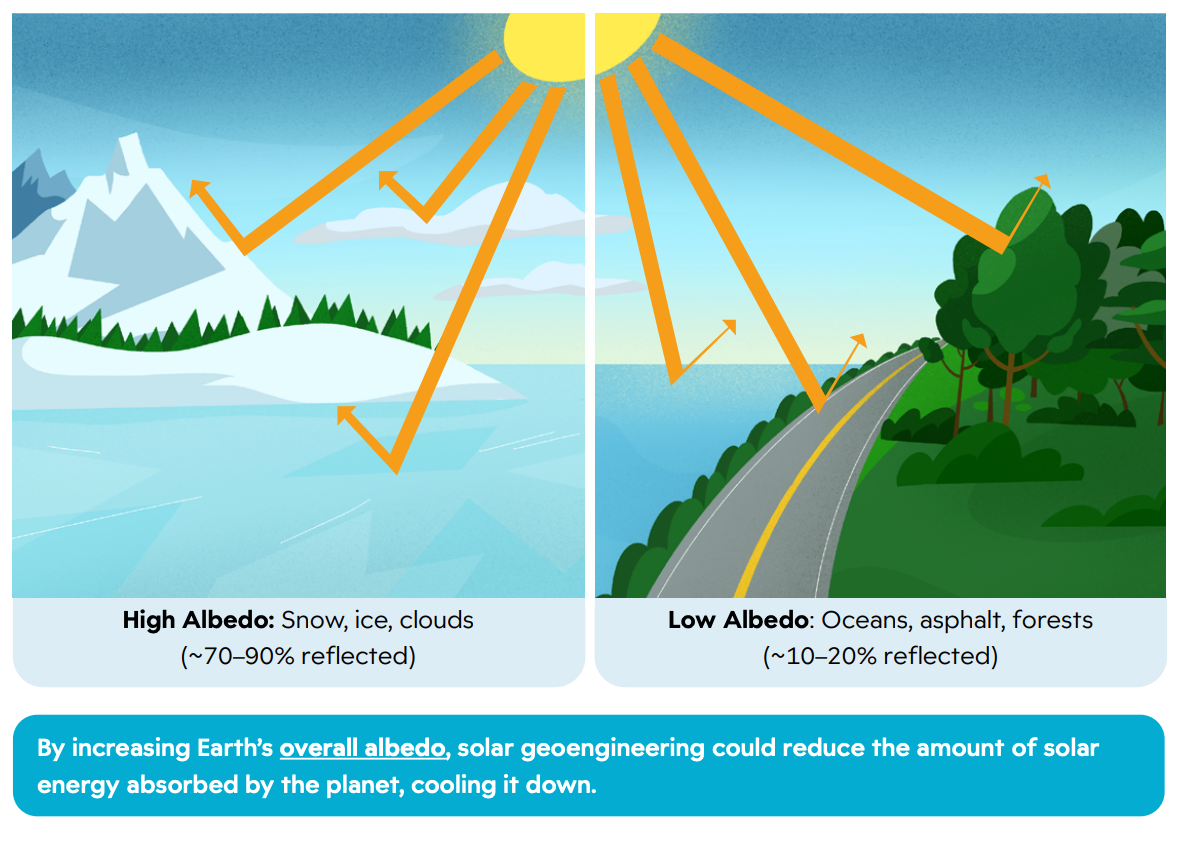
Solar geoengineering methods aim to enhance Earth’s reflectivity by mimicking or amplifying these natural processes. If the sunlight is reflected rather than entering Earth’s energy system, it reduces heat trapped by GHGs, effectively ‘turning down the heat’ on the planet.
So what can solar geoengineering do, and what can’t it?
Solar geoengineering could:
- Provide regional or global cooling
- Reduce the frequency and intensity of heatwaves
- Possibly slow the approach of some climate tipping points, such as ice loss.
Solar geoengineering cannot resolve the root cause of human-induced climate change – increased GHGs. It also may have unforeseen risks and uncertainties, including:
- Changes to rainfall and monsoon patterns
- Ozone layer damage that could increase UV radiation exposure
- Termination shock, the idea that if solar geoengineering is halted suddenly, rapid warming could occur
- Potential negative impacts on ecosystems and human health
Each of these risks would need to be weighed against the impacts of the warming that solar geoengineering is meant to reduce.
Types of Solar Geoengineering Approaches
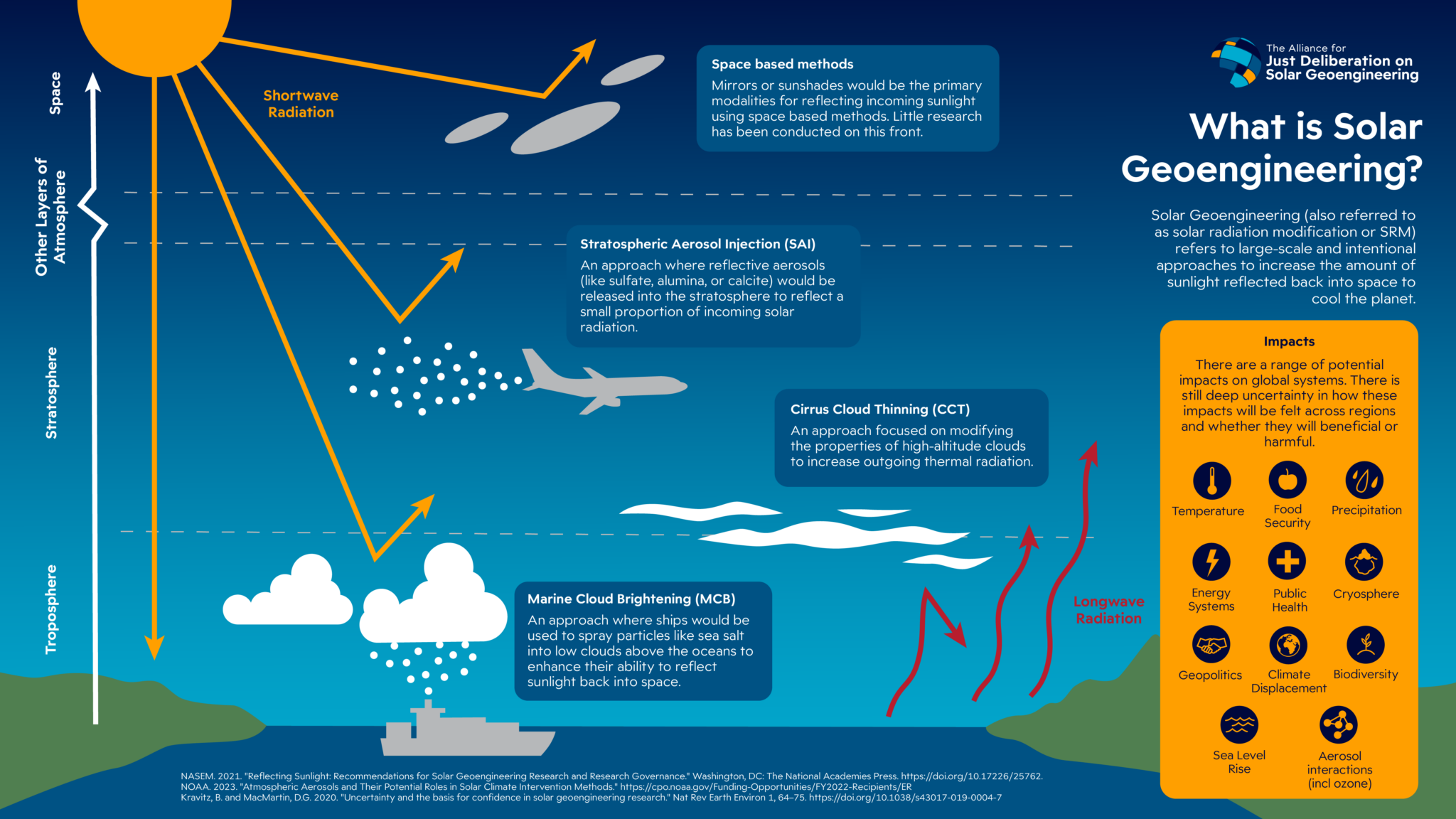
Three primary approaches to solar geoengineering are being considered: stratospheric aerosol injection, marine cloud brightening, and cirrus cloud thinning. Other methods such as surface brightening and space-based techniques are also being investigated.
Stratospheric Aerosol Injection
Stratospheric Aerosol Injection (SAI) is the largest in scale and potentially most impactful. The process involves releasing tiny reflective particles (aerosols), such as sulfates, into the stratosphere, which is ~10–50 km above Earth’s surface. These particles scatter sunlight, reducing the amount of solar energy that reaches the planet.
The reflective particles could be released via high-altitude aircraft, balloons, or another system. Once released, the aerosols spread widely across the stratosphere, creating a thin layer that reflects sunlight before it reaches the Earth’s surface. SAI could provide rapid cooling, reducing global temperatures within months.
SAI mimics the natural cooling effects of volcanic eruptions, such as Mount Pinatubo’s eruption in 1991, which lowered global temperatures by approximately 0.5°C for nearly two years after injecting almost 20 million tons of sulfur dioxide into the stratosphere. While this event demonstrated how injecting reflective particles into the stratosphere can lower global temperatures, it also highlighted potential side effects, such as altered rainfall patterns and regional climate disruptions. For instance, Pinatubo’s eruption disrupted the Asian monsoon and reduced precipitation in some areas.
Relative to its potential impact, SAI is inexpensive to deploy. Research estimates that the aircraft, materials, and everything else needed for deployment amounts to $18-20 billion per year for each degree of cooling, which puts it within reach for individual countries or wealthy institutions. Deployment is not the only expense, though. Other significant costs like ongoing monitoring and governance would add to the total, and SAI would not replace the cost of reducing GHG emissions, which will only rise the longer society stalls on climate action. Notably, SAI deployment would likely require a sustained intervention strategy over a period of decades or until atmospheric emissions are brought down to safer levels.
Marine Cloud Brightening
Marine cloud brightening (MCB) would cool the Earth by enhancing the reflectivity of low-lying marine clouds over oceans. The idea is to spray tiny sea salt particles into these clouds, increasing the density of cloud droplets and making the clouds brighter. Brighter clouds reflect more sunlight back into space, increasing the cloud’s reflectivity.
“Ship tracks” offer a real-world example of MCB in action. Ship exhaust particles help form clouds, and these narrow, bright cloud trails reflect more sunlight, limiting its ability to reach and heat the ocean.

MCB could help reduce regional temperatures, potentially mitigating some of the effects of climate change. Cost estimates are currently limited and uncertain but would generally be in the range of billions to tens of billions per year, depending on scale. In Australia, researchers have been exploring MCB since 2020 as a potential tool to protect the Great Barrier Reef from coral bleaching.
Cirrus Cloud Thinning
Cirrus cloud thinning (CCT) involves adding tiny particles into the upper troposphere to make cirrus clouds thinner and reduce their lifetime. Thinner clouds let more heat escape from Earth into space, helping to provide regional or global cooling.
At present, CCT has been on the backburner in conversation because poorly understood cloud dynamics make it highly uncertain. Its scalability is underexplored, and it may disrupt rain and weather patterns.
Small-scale surface brightening and space-based techniques are also being explored, but to date SAI and MCB have received the most attention and been most widely studied. SAI would have the most vast impacts and consequences and require the most complex governance, making it the primary focus of DSG’s international work and thought leadership.
Is Solar Geoengineering Happening?
Solar geoengineering is not currently being deployed at a scale intended to meaningfully alter the global climate, though small-scale outdoor experiments and activities have taken place. While interest, funding, and research on the topic have increased, the technology is still in the research stage. The majority of solar geoengineering research is done through modelling, but projects involving small-scale outdoor research are increasingly being explored. Some isolated actors discuss deployment in the near-term, but the vast majority of people working on this topic understand there is much research to still be done. A more hesitant set of actors are of the mindset that research, funding, and attention towards solar geoengineering creates a slippery slope toward deployment. This concern underscores why proactive governance is so important.
Research happening on solar geoengineering takes many forms.
- Computer models and simulations aim to predict and analyze solar geoengineering’s potential impacts, benefits, and risks;
- Lab experiments study processes in controlled settings;
- Outdoor experiments aim to evaluate solar geoengineering’s practical effectiveness and environmental impacts in a real-world environment.
- Observational studies analyze natural processes, such as volcanic eruptions, to understand how aerosols affect the climate.
- Social science research is also critical to the field and to furthering the understanding of societal, ethical, and governance implications.
- Impacts research (usually done at the scale of a region or country) studies the environmental, social, economic, and health effects of proposed solar geoengineering.
Research on solar geoengineering is undertaken by a variety of institutions, including universities, government research agencies, nonprofits and think tanks, and philanthropies. Learn more about these actors and others, who are also contributing to work on governance, ethics, and policy, in our 2025 landscape overview.
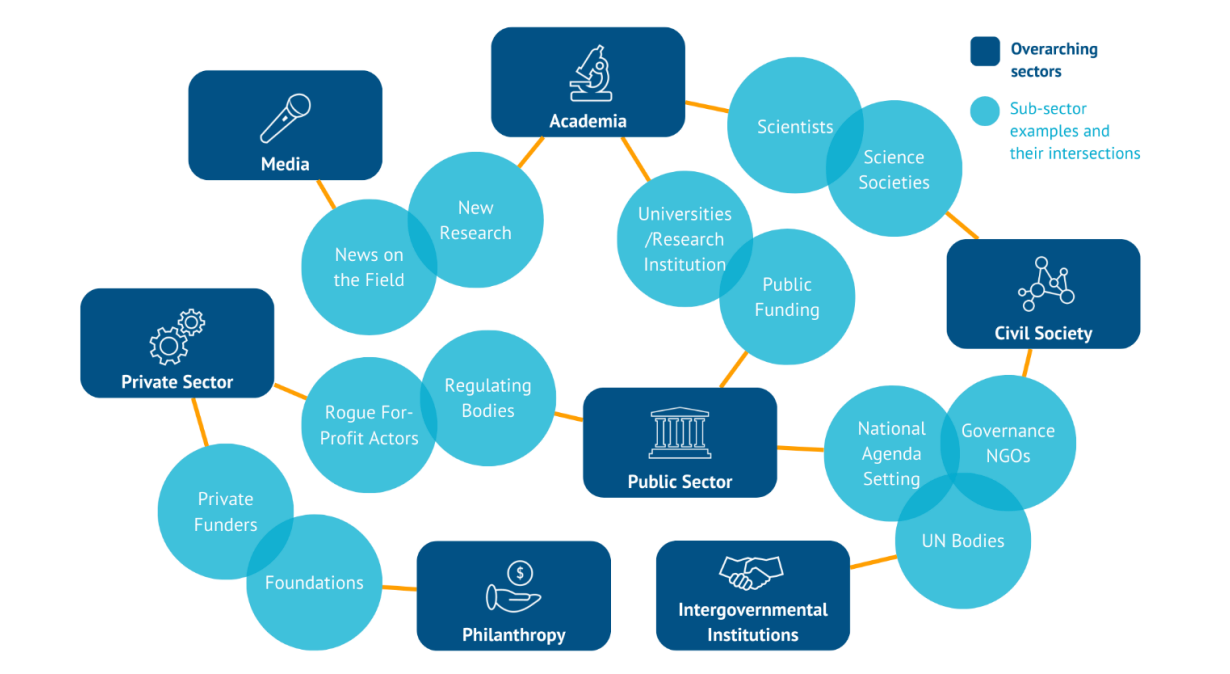
Funding for solar geoengineering has significantly increased in recent years, though still comes from a small set of actors. Public and philanthropic funding for research has largely come from governments (including the US, UK, and Australia) and foundations (including Quadrature Climate Foundation and the Simons Foundation). Separately, private investment in for-profit companies has surged since 2025 and, according to a funding tracker from SRM360, now exceeds any single research funder.
It is important that the governance of solar geoengineering develops as research, funding, and interest do. It has been seen too often with other emerging technologies that governance is not established until it is too late.
Who Decides on Solar Geoengineering? Governance and Global Oversight
As discussions around solar geoengineering grow, urgent questions about oversight, accountability, and global cooperation must be raised. The potentially global impacts of the technology make these questions critical. Effective governance could ensure solar geoengineering research and potential deployment are guided by transparency, justice, and international cooperation. It could also reduce known risks, shed light on unknown risks, prevent misuse, and foster public trust.

A lack of robust frameworks surrounding solar geoengineering could lead to unintended consequences, exacerbate inequality, and potentially spark geopolitical tensions or enable unilateral actions. The places most exposed to climate change often have the least say in decisions about solar geoengineering, and could also be the most affected by its side effects. Who decides is as central a question as what the technology does.
At present, there is global debate as to whether solar geoengineering research should be restricted or supported. Those who advocate for restricting it stand by the slippery slope argument and also believe there is a ‘moral hazard’; that the existence of SRM research and knowledge could weaken political will for emissions reductions and adaptation. These parties push for bans, moratoriums, and funding restrictions.
Those who support research believe that it will reduce uncertainty, allowing for a better understanding of the risks and impacts of the technology, ensuring decisions are based on science rather than speculation. Research supporters advocate for science-based decision-making that will strengthen decisions on use or non-use, rather than undermining them. Many see value in creating platforms for data and research sharing across institutions and geographies and the development of ethical guidelines for research.
Of course, many fall somewhere between these two perspectives, curious to learn more as the space evolves. The debates and governance pathways in motion today are of critical importance, charting the path towards a future where solar geoengineering is either deployed or not. DSG tracks international solar geoengineering governance actions here.
What comes next?
The solar geoengineering debate is quickly accelerating. Private experimentation is taking place, political polarization is increasing, and climate pressures are rising. That being said, efforts are continuously being made to develop early governance, fund research that will help the world understand the global and regional impacts of solar geoengineering, and broaden the geographic reach of the conversation.
Solar geoengineering is not a solution to climate change. It is one possible tool, alongside mitigation and adaptation, that could reduce some impacts of warming while emissions are brought down. Mitigation and adaptation remain the priority and deserve far more attention and funding.
DSG exists to foster just and inclusive deliberation about research and potential use of solar geoengineering. We empower civil society and policy actors to engage in solar geoengineering governance and decision-making. While DSG supports well-governed research, as a non-advocacy organization we do not take a position for or against solar geoengineering deployment in the future. Explore our Learning Resources to dive deeper into the topic and keep reading to learn more about the risks and benefits of solar geoengineering, and some common myths.
Join Our Community
Stay informed about the latest developments in solar geoengineering and how you can make a difference. Subscribe to our newsletter for insights, updates, and opportunities to get involved.
Latest Posts

Solar Radiation Modification (SRM): Common Myths and Claims

Risks and Benefits of Solar Geoengineering Explained

Big ambitions, bigger questions: Our takeaways from Reykjavik

Solar geoengineering: What is it? A plain-language guide.

DSG expands solar geoengineering learning resources with new languages, videos, and explainers

Before the Rules Catch Up: What AI’s Pace and Safety Challenges Mean for SRM Governance