
Risks and Benefits of Solar Geoengineering Explained

What we know about solar geoengineering, what remains uncertain, and why it matters.
New technologies often carry uncertainty, and the larger the potential consequences, the more scrutiny they deserve. People want to fully understand the risks and benefits of something that might affect their lives. For solar geoengineering, these uncertainties have fueled concern, but also a growing curiosity and desire to keep learning. Below, we explore what is currently known about the potential risks and benefits of solar geoengineering, what remains uncertain, and how to navigate those uncertainties as research and dialogue move forward.
Solar geoengineering (also referred to as solar radiation modification or SRM) refers to proposed large-scale and intentional efforts to reflect more sunlight back into space to cool the planet and help counteract some climate change impacts. There are multiple proposed methods of solar geoengineering – the two most commonly discussed are stratospheric aerosol injection (SAI) and marine cloud brightening (MCB). At present, these technologies are in the research stage.
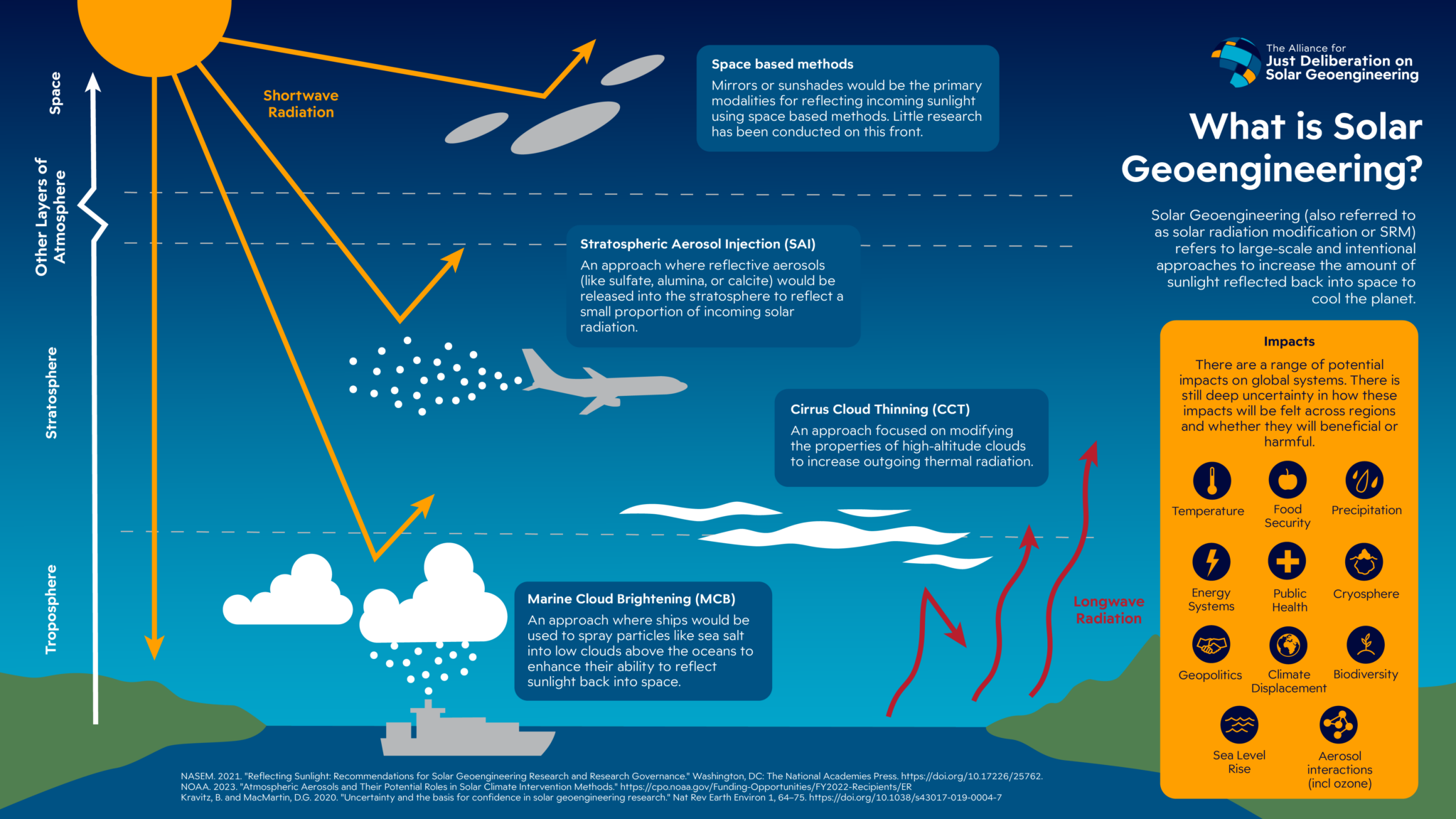
Explore this explainer for more information on each.
Why Assessing Risks and Benefits is Difficult
Solar geoengineering – specifically SAI – cannot be trialed at a large scale simply to see what happens. The Silicon Valley mantra of “move fast and break things” is hardly appropriate when the stakes involve the global atmosphere. This makes understanding the potential risks and benefits difficult. Two main factors limit our ability to gather the real-world data needed to assess its effects.
First, while the climate models researchers develop and utilize are a very useful starting point, the Earth is an incredibly dynamic and changing system. Models don't reflect exact real-world conditions and come with uncertainties. Human-induced climate change has made the accuracy of climate modelling even more challenging and when modelling for the purpose of exploring solar geoengineering, that requires adding another layer of uncertainty on top.
Second, outdoor experiments can carry risks, including political and ethical ones – several high-profile projects have been canceled following public opposition. Part of the problem is that it’s hard to tell where experimentation ends and deployment begins. Lack of public engagement has been a recurring concern that leads to distrust. This public distrust is compounded by the absence of international regulations or a set of guidelines to govern outdoor geoengineering activities. One prominent example is the Stratospheric Controlled Perturbation Experiment (SCoPEx), which attracted widespread media attention after the Saami Council and other groups opposed plans for field trials in northern Sweden, raising concerns about inadequate consultation and the implications of conducting this kind of research in the region.
Given the challenges that come with conducting outdoor experiments, models remain the primary source of our current knowledge about solar geoengineering. These models can help us "explore the consequences of human choices, providing an essential input alongside other more subjective, but no less important, factors." While modelling alone will never provide a clear conclusion on whether solar geoengineering should happen or not, the findings can help support decision-making by simulating scenarios under which solar geoengineering could be rolled out: both the ideal ones and the complicated, less predictable ones.
Nearly as important as what we know is understanding what we don’t know and what uncertainties could be meaningful and consequential. Resources like Reflective’s uncertainty database exist to help the field understand which gaps in knowledge are most important to real-world decision making and what kind of research could be done to reduce them.
Below, we explain the benefits and risks of solar geoengineering as they are understood by current research.
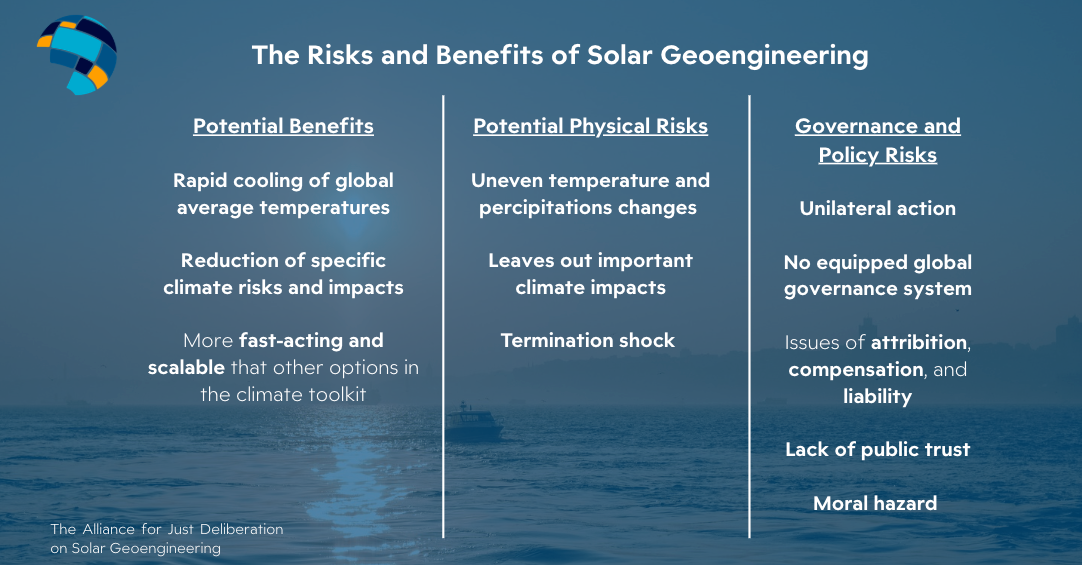
What Are the Potential Benefits?
Solar geoengineering is the only currently understood set of approaches that could directly address some impacts of climate change by cooling the planet. While it cannot replace emissions reduction and carbon removal, it could potentially act as a temporary buffer against some severe climate effects, many of which will continue to worsen for decades even if rapid emissions reductions begin today.
The most obvious benefit of solar geoengineering would be the potential for rapid cooling of global average temperatures. SAI specifically could lower global temperatures within months, buying time for emissions reductions and other solutions to take shape. It also has the potential to reduce specific climate risks and impacts, including the frequency and intensity of heatwaves, which would decrease instances of heat-related illnesses and deaths. Through temperature reduction, it may also be able to help slow the approach of some tipping points like Arctic ice melt and permafrost thaw, which drive sea level rise and greenhouse gas release.
SAI would also be more fast-acting and scalable than other options in the climate toolkit. It is the fastest-known way to decrease global temperatures – reducing them by degrees within years rather than decades. Compared to emissions reduction, carbon removal, and adaptation measures, the price tag on SAI is also fairly reasonable. It is critical to keep in mind, though, that solar geoengineering does not reverse climate change as it can’t remove or reverse the primary cause, fossil fuel emissions. Any deployment must be accompanied by strong climate action.
What Are The Potential Physical Risks?
Solar geoengineering carries both known risks and significant uncertainties for the global climate and ecosystems. One thing we do know is that regional temperature and precipitation changes will be uneven. This could cause droughts, floods, or other disruptive weather for regions and communities that rely on certain weather patterns for agriculture and their livelihoods.
Importantly, solar geoengineering couldn’t address all climate impacts – just the reflectivity of sunlight, and therefore temperature and dependent weather patterns. Other symptoms of climate change, like ocean acidification, can only be aided by emissions reductions. Deployment therefore creates a new climate system with its own benefits, risks, and unintended consequences.
In some scenarios, another risk could be termination shock. Abruptly stopping the use of solar geoengineering while greenhouse gas emissions remain high could trigger rapid temperature increase and other abnormal fluctuations, leaving ecosystems and communities little time to adapt.
What Are The Governance and Policy Risks?
Many of the characteristics that make SAI attractive also generate risks when it comes to governance. Because SAI deployment would be relatively inexpensive and fast-acting, a single powerful country, or even a well-funded private actor, could act alone, in principle. This isn’t just hypothetical. Private companies are raising tens of millions of dollars to develop deployment technology, and at least one has sold “cooling credits” for small releases of sulfur dioxide, all in the absence of any agreed rules.
Few technologies force the question of global cooperation as clearly as solar geoengineering does. Critically, there is no global governance system right now. No international framework exists for research or deployment, leaving room for uncoordinated and unilateral actions with global consequences. Without an international mechanism, decision-making excludes low-income countries, Indigenous communities, and other populations that may face disproportionate impacts.
Deployment would also raise global questions that no existing institution is equipped to answer. One question is attribution: once sunlight is being reflected, any drought, flood, or failed harvest could be blamed on it, and current science can’t cleanly separate the intervention’s influence from natural variability in individual events. There is also no mechanism for compensation or liability. Countries would likely disagree about how much cooling to aim for and which aerosols to use. And because stopping abruptly carries the risk of termination shock described above, deployment would require institutions capable of sustaining a program for decades, through changes of government and shifts in public opinion.
Public trust is also at risk. Research is concentrated in the world’s richest countries, which worsens power imbalances and erodes trust. And even within those countries, limited public engagement fuels misinformation and conspiracy theories. Bans have already been attempted in over half of U.S. states, and movements like the Non-Use Agreement call for a moratorium on solar geoengineering research, citing it as “highly speculative” and “ungovernable.”
One additional concern often cited in those forums is “moral hazard,” the idea that even researching and discussing solar geoengineering could weaken incentives to cut emissions. The evidence on this has been less worrying than the theory: experimental and large-scale survey studies have mostly found little effect on individuals engaging in mitigation, and in some cases the opposite. Critics respond that the real risk lies with governments and institutions rather than individuals, and that is hard to test.
Questions like “who decides?” and “who bears the consequences?” are at the center of all of these risks. The answers to these questions carry weight for both global politics and the communities most exposed.
How Can Research Reduce These Uncertainties?
Aside from the benefits and risks that we have begun to understand, there is still so much to learn through models, and potentially real-world experiments, about the impacts solar geoengineering would have on climate processes. Its impacts on different geographies and livelihoods, under different injection scenarios, remain largely unknown. Existing climate models can estimate the effects of changes in temperature and precipitation, but primarily do so at a broad level that can’t provide firm conclusions for nations or communities. For communities and decision makers to understand the direct impacts solar geoengineering may have on them, more technical capacity and resources are needed to sift through dense data. This is called downscaling and is something that is only beginning to take place for solar geoengineering.
As many developing countries lack the technical capacity and resources to do this, the conclusions of existing models have to be taken with lower confidence. To combat this uncertainty, organizations like the Degrees Initiative are funding local impacts research that builds the capacity of climate-vulnerable Global South countries to investigate questions about solar geoengineering themselves and understand the gaps or discrepancies in, aiding in reducing uncertainties.
Another blind spot is the impacts that solar geoengineering will have on the non-human: animals, plants, agriculture, and ecosystems as a whole. Early studies show a mix of positive and negative consequences. For example, a study by South African researchers reveals that under a certain set of deployment conditions, SAI would economically benefit livestock production in some regions of Africa, but cause it to suffer in others. Another study concludes that in Africa’s Gulf of Guinea, one deployment scenario of SAI may support the stabilization of marine ecosystems. However, there are many more species, ecosystems, and scenarios to explore before scientists are able to answer the questions that communities may raise.
Important questions remain about how solar geoengineering might be implemented. Decisions about which aerosols would be used, where they would be released, and how much cooling to aim for would each carry different risks and consequences. These choices also raise challenging social, political and governance questions, particularly when countries and communities may disagree about which outcomes are desirable and whose interests should take priority. Solar geoengineering’s complexity and trade-offs demand further social science research as well.
Comparing Risks of Action and Inaction
Solar geoengineering is being considered because climate change poses serious risks, and those risks will grow without sufficient action. Understanding whether solar geoengineering could help requires comparing its potential risks and benefits with what might happen in a world without it. Neither option is risk-free. Solar geoengineering could introduce new problems, but choosing not to use it could also mean facing greater warming and more severe climate impacts. This approach, known as risk-versus-risk, helps put the trade-offs into perspective and ensures that decisions account for them.
One assessment cites three main risks inherent to any geoengineering method: 1) it doesn’t work; 2) it causes harm (to biophysical and social systems); 3) it worsens international tensions. Each applies just as directly to the fight against climate change itself and may help contextualize the trade-off between climate response options.
It doesn’t work: Solar geoengineering could be less effective at scale than anticipated, or its regional effects could prove too uneven to manage. Similarly, humans risk failing to sufficiently deliver on climate action. The climate targets established by the UN and scientific bodies set out to protect from the worst impacts of climate change but, at present, climate action isn’t on pace.
It causes harm: Changing weather patterns and termination shock are some of the real risks of deploying solar geoengineering. However, climate change is already causing harm on a significant scale – intensifying heatwaves, accelerating sea level rise, and pushing toward tipping points like permafrost thaw.
It worsens international tensions: Unilateral or secretive deployment of solar geoengineering could destabilize international politics. But unmitigated climate change is already a source of tension, driving resource scarcity and climate-induced migration that strain the same security dynamics.
Weighing these risks against each other, rather than evaluating solar geoengineering on its own, is critical to understanding the full range of trade-offs involved in any decision, including the decision not to proceed with solar geoengineering.
What This Means for Decision-Making
Since uncertainty and risk will never fully be eliminated, the work is to manage and understand them. For us at DSG, this means promoting inclusive, well-governed research that helps reveal the risks at hand, paired with early and inclusive governance. As the field moves forward with both indoor and outdoor experiments to continue narrowing uncertainties, a set of principles or guidelines needs to be built in order to develop public trust. This is especially critical as the prospect of outdoor experiments impacting local communities increases.
Transparency needs to extend to who gets a seat at the table and who develops the principles or guidelines. Decision-making must broaden beyond scientists and governments to include the communities and stakeholders most likely to be affected by both climate change and the interventions proposed to address it.
Solar geoengineering will remain contested, and rightly so: the uncertainty and questions it raises about power, equity, and planetary-scale intervention deserve rigorous debate. The more we can continue to fill the gaps and answer questions in public, with full participation of those affected, the better.
Join Our Community
Stay informed about the latest developments in solar geoengineering and how you can make a difference. Subscribe to our newsletter for insights, updates, and opportunities to get involved.
Latest Posts

Solar Radiation Modification (SRM): Common Myths and Claims
Risks and Benefits of Solar Geoengineering Explained

Big ambitions, bigger questions: Our takeaways from Reykjavik


Solar geoengineering: What is it? A plain-language guide.

DSG expands solar geoengineering learning resources with new languages, videos, and explainers
Before the Rules Catch Up: What AI’s Pace and Safety Challenges Mean for SRM Governance